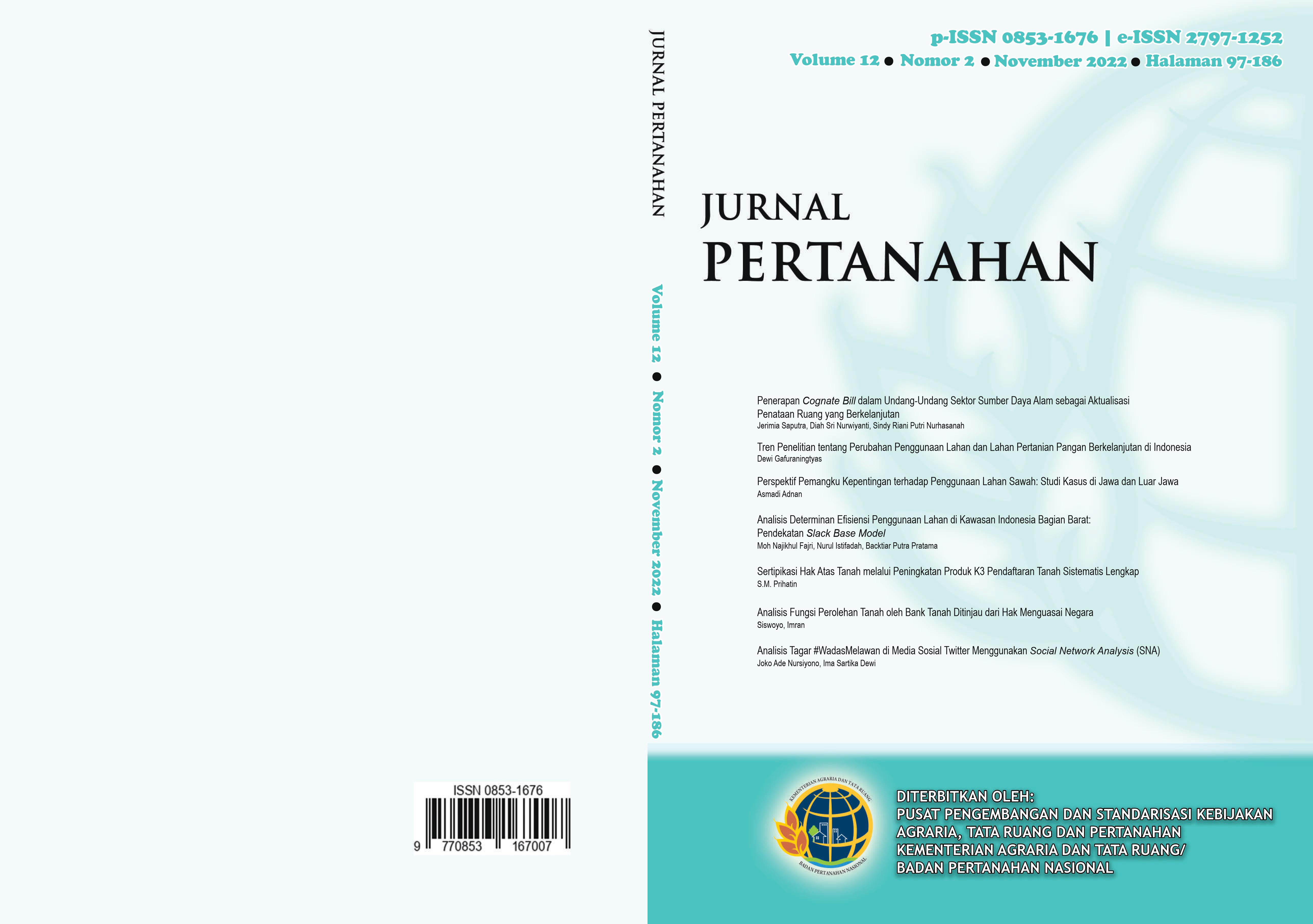
Analisis Fungsi Perolehan Tanah oleh Bank Tanah Ditinjau dari Hak Menguasai Negara
DOI:
https://doi.org/10.53686/jp.v12i2.184Keywords:
hak, tanah, bank, negaraAbstract
ABSTRAK
Lahirnya UU No. 11 Tahun 2020 tentang Cipta Kerja yang melahirkan Bank Tanah dengan fungsi perolehan tanah banyak
mengalami kritikan di kalangan masyarakat dan pemerhati agraria dikarenakan dianggap bertentangan dengan hak
menguasai negara terhadap bumi, air, dan kekayaan di dalamnya pada Pasal 33 Ayat (3) UUD Tahun 1945. Tujuan dari
penelitian ini adalah untuk mengetahui konsep hak menguasai dari negara sesuai dengan Pasal 33 Ayat (3) UUD 1945 serta
mengetahui fungsi perolehan tanah oleh Bank Tanah ditinjau dari hak menguasai dari negara. Penelitian ini adalah penelitian
doktrinal yang memanfaatkan bahan hukum primer dan sekunder berupa peraturan perundang-undangan, putusan-putusan
pengadilan, dan sejumlah literatur yang membahas mengenai objek penyelidikan. Pendekatan yang digunakan adalah
perundang-undangan dan konseptual. Bahan yang terkumpul dianalisis secara deskriptif kualitatif. Hak menguasai oleh
negara pada Pasal 33 Ayat (3) UUD Tahun 1945 adalah konsepsi kedaulatan rakyat sebagai pemilik bumi, air dan kekayaan
alam di dalamnya yang kemudian rakyat secara kolektif memberikan mandat kepada negara untuk mengadakan kebijakan
(beleid), tindakan pengurusan (bestuursdaad), pengaturan (regelendaad), pengelolaan (beheersdaad) dan pengawasan
(toezichthoudensdaad) untuk tujuan sebesar-besarnya kemakmuran rakyat. Hadirnya Bank Tanah dengan fungsi perolehan
tanah membuat hak menguasai negara terhadap tanah mengalami perkembangan dibanding sebelumnya. Negara dapat
melakukan tindakan pengelolaan (beheersdaad) terhadap tanah melalui instrumen badan hukum negara yaitu Bank Tanah.
ABSTRAK
The birth of Law no. 11 of 2020 concerning Job Creation, which gave birth to a Land Bank with the function of acquiring land,
has experienced a lot of criticism among the public and agrarian observers because it is considered contrary to the state’s
right to control the earth, water, and wealth in Article 33 Paragraph (3) of the 1945 Constitution of the Republic of Indonesia.
The purpose of this study is to determine the concept of state control rights in accordance with Article 33 Paragraph (3)
of the 1945 Constitution of the Republic of Indonesia and to find out the function of land acquisition by the Land Bank in
terms of state control rights. This research is a doctrinal research that utilizes primary and secondary legal materials in
the form of laws and regulations, court decisions, and a number of literatures that discuss the object of investigation. The
approach used is statutory and conceptual. The collected materials were analyzed descriptively qualitatively. The right to
control by the state in Article 33 Paragraph (3) of the 1945 Constitution of the Republic of Indonesia is the concept of people’s
sovereignty as the owner of the earth, water and natural resources in which the people collectively give a mandate to the state
to make policies (beleid), management actions (bestuursdaad), regulation (regelendaad), management (beheersdaad) and
supervision (toezichthoudensdaad) for the purpose of the greatest prosperity of the people. The presence of the Land Bank
with the function of land acquisition has made the state’s right to control land more developed than before. The state can carry
out management actions (beheersdaad) on land through the instrumen of a state legal entity, namely the Land Bank.
Downloads
Published
How to Cite
Issue
Section
License
Copyright (c) 2022 Jurnal Pertanahan

This work is licensed under a Creative Commons Attribution-NonCommercial-ShareAlike 4.0 International License.
Copyright @2021. This is an open-access article distributed under the terms of the Creative Commons Attribution-NonCommercial-ShareAlike 4.0 International License (http://creativecommons.org/licenses/by-nc-sa/4.0/) which permits unrestricted non-commercial use, distribution, and reproduction in any medium.