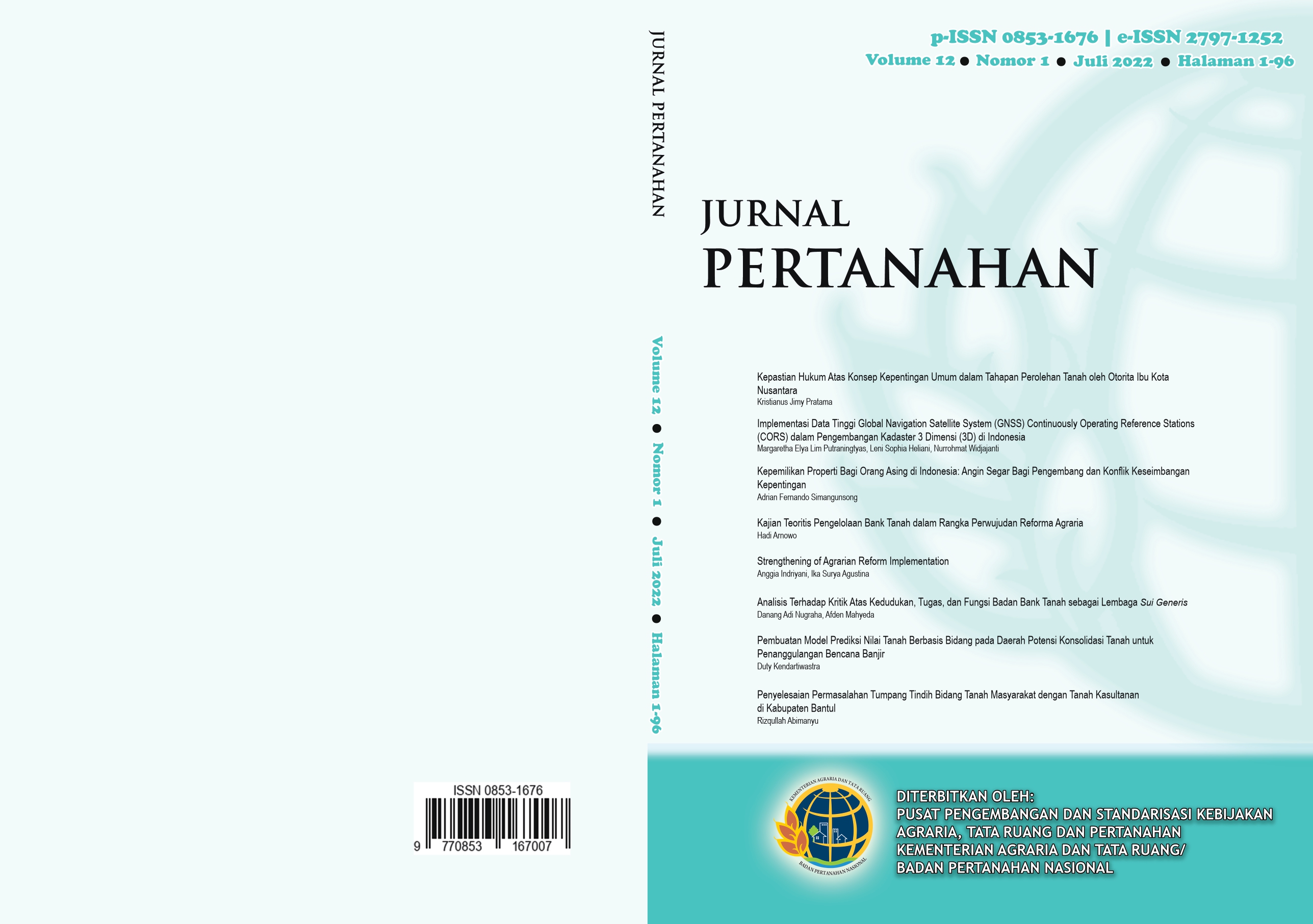
Implementasi Data Tinggi Global Navigation Satellite System (GNSS) Continuously Operating Reference Stations (CORS) dalam Pengembangan Kadaster 3 Dimensi (3D) di Indonesia
DOI:
https://doi.org/10.53686/jp.v12i1.128Keywords:
kadaster 3 D, sistem tinggi, GNSS CORS, 3D cadastre, height systemAbstract
Abstrak
Representasi sistem kadaster 3D membutuhkan kerangka teknis dalam hal ketelitian posisi dan syarat-syarat teknis. Sistem tinggi yang mempunyai georeferensi pada sistem koordinat horizontal dan vertikal tertentu dapat menentukan lokasi properti dan hubungan geometrik model kadaster 3D. Salah satu solusi alternatif penentuan sistem koordinat vertikal adalah menggunakan tinggi ortometrik yang diikatkan pada sistem tinggi nasional. Seiring dengan perkembangan kadaster 3D dalam beberapa dekade terakhir, berkembang juga teknologi termasuk akuisisi data kadaster 3D, validasi data, dan visualisasi data untuk memenuhi kebutuhan dasar kadaster 3D. Pengukuran objek kadaster 3D secara teliti, baik secara horizontal dan vertikal didukung oleh teknologi pengukuran yang berkembang sangat pesat, seperti GNSS CORS dan laser scanner. Tujuan penyusunan makalah ini adalah menyediakan data kadaster 3D dalam membangun sistem kadaster digital, validasi, dan pemodelan kadaster 3D. Kadaster 3D direpresentasikan menggunakan sistem tinggi ortometrik yang dihasilkan oleh teknologi GNSS CORS dalam tinggi elipsoid. Objek kadaster penelitian adalah Rusunawa Gemawang 2 dan Apartemen Student Park yang mewakili objek rumah susun. Proses georeferensi Rusunawa Gemawang 2 menghasilkan RMSE georeferensi minimum 0,008 m dan maksimum 0,017 m, sementara Apartement Student Park menghasilkan RMSE minimum 0,007 m dan maksimum 0,020 m. Model kadaster 3D divisualisasikan dalam bentuk ruang di tiap-tiap level dan memberikan gambaran geometrik 3D. Konversi tinggi dari tinggi elipsoid menjadi ortometrik merupakan salah satu tantangan dalam representasi kadaster 3D di Indonesia.
ABSTRACT
The representation of the 3D cadastral system requires a technical framework in terms of positional precision and technical requirements. Height systems that have georeference in certain horizontal and vertical coordinate systems can determine the location of properties and geometric relationships cadastre model. One alternative solution for determining the vertical coordinate system is to use an orthometric height tied to the national height system. Along with the development of the 3D cadastre in the last few decades, technology has also evolved including 3D cadastral data acquisition, data validation, and data visualization to meet the basic needs of the 3D cadastre. The meticulous measurement of 3D cadastral objects, both horizontally and vertically, is supported by rapidly developing measurement technologies, such as GNSS CORS and laser scanners. The purpose of this paper is to provide 3D cadastral data in building a digital cadastral system, validation, and 3D cadastral modeling. The 3D cadastre is represented using the orthometric height system generated by GNSS CORS technology using the elipsoid height. The object of the research cadastre is Rusunawa Gemawang 2 and Student Park Apartment which represent the apartment object. The georeferenced process of Rusunawa Gemawang 2 produces a minimum RMSE of 0.008 m and a maximum of 0.017 m, while the Student Park Apartment produces a minimum RMSE of 0.007 m and a maximum of 0.020 m. The 3D cadastral model is visualized in the form of a space at each level and provides a 3D geometric picture. Converting height from ellipsoid height to orthometric is a challenge in 3D cadastral representation in Indonesia.
References
Aien, A. (2013). 3D Cadastral Data Modelling. The University of Melbourne, Victoria, Australia.
Alkan, R. M. et al. (2015). Usability of GNSS Technique For Cadastral Surveying, in World Cadastre Summit, Istanbul. Istanbul, pp. 266–286.
Antova, G. (2019). Evaluation of Factors, Influencing the Accuracy of the Digital Model, Obtained by Laser Scanning. IOP Conference Series: Earth and Environmental Science, 362(1). doi: 10.1088/1755-1315/362/1/012129.
Barthelmes, F. (2013). Definition of Functionals of the Geopotential and Their Calculation from Spherical Harmonic Models. Potsdam, Germany. Available at: http://icgem.gfz-potsdam.de/ICGEM/.
Biljecki, F., Ledoux, H., Stoter, J., & Zhao, J. (2014). Formalisation of the Level of Detail in 3D City Modelling. Computers, Environment, and Urban Systems, 48, 1–15. https://doi.org/10.1016/j.compenvurbsys.2014.05.004.
Burns, D. and Sarib, R. (2010). Standards and Practices for GNSS CORS Infrastructure, Networks, Techniques and Applications’, in FIG Congress 2010. Sydney.
Chiang, H. (2012). Data Modelling and Application of 3D Cadastral in Taiwan, in 3 rd International Workshop on 3D Cadastres: Developments and Practices. Shenzhen, China, pp. 137–158.
Erba, D. A. et al. (2014). Height Reference for Parcels and Land Objects for the 3D Cadastres Structuring, in 4th International Workshop on 3D Cadastres. Dubai, United Arab Emirates, pp. 159–172.
Featherstone, W. E., Dentith, M. C. and Kirby, J. F. (1998). Strategies for the accurate determination of orthometric heights from gps, Survey Review, 267(January), pp. 278–296.
Gröger, G., Kolbe, T., Nagel, C., & Häfele, K.-H. (2012). OGC City Geography Markup Language (CityGML) En-coding Standard. Ogc, 1–344. https://doi.org/OGC 12-019
Guo, R. et al. (2014). The Applications and Practices of 3D Cadastre in Shenzhen, International Workshop on 3D Cadastre, Dubai, United Arab Emirates, (November), pp. 299–312.
Jazayeri, I., Rajabifard, A. and Kalantari, M. (2014). A geometric and semantic evaluation of 3D data sourcing methods for land and property information, Land Use Policy. Elsevier Ltd, 36, pp. 219–230. doi: 10.1016/j.landusepol.2013.08.004.
Karaaslan, Ö., Tanır Kayıkçı, E. and Aşık, Y. (2016). Comparison of local geoid height surfaces, in the province of Trabzon, Arabian Journal of Geosciences, 9(6), pp. 1–12. doi: 10.1007/s12517-016-2470-2.
Karabin, M. (2014). A Concept of a Model Approach to the 3D Cadastre in Poland: Technical and Legal Aspects, in 4th International Workshop on 3D Cadastres. Dubai, United Arab Emirates, pp. 281–298.
Kedzierski, M. and Fryskowska, A. (2015). Methods of laser scanning point clouds integration in precise 3D building modelling, Measurement. Elsevier Ltd, 74, pp. 221–232. doi: 10.1016/j.measurement.2015.07.015.
Knoth, L., Atazadeh, B. and Rajabifard, A. (2020). Land Use Policy Developing a New Framework Based on Solid Models for 3D Cadastres, Land Use Policy. Elsevier, 92(January), p. 104480. doi: 10.1016/j.landusepol.2020.104480.
Lee, J., Park, B. and Tcha, D. (2012). Using Network-RTK for Cadastral Reform In Republic of Korea Using Network-RTK for Cadastral Reform in Republic of Korea, in FIG Working Week. Rome, Italy, pp. 6–10.
Leica Geosystems (2017). ‘Leica BLK360: User Manual’.
Lemmen, C. and Oosterom, P. V. A. N. (2010). The Modelling of Spatial Units ( Parcels ) in the Land Administration Domain Model ( LADM), in The Modelling of Spatial FIG Congress 2010. Sydney, Australia, pp. 11–16.
Navratil, G. et al. (2014). Visibility Analysis in a 3D Cadastre, in 4th International Workshop on 3D Cadastres. Dubai, United Arab Emirates, pp. 183–196.
Navratil, G. and Unger, E. M. (2013). Reprint of: Requirements of 3D cadastres for height systems, Computers, Environment and Urban Systems. Elsevier Ltd, 40, pp. 14–23. doi: 10.1016/j.compenvurbsys.2013.04.001.
Putraningtyas, M.E.L. (2022). Pengembangan Pengukuran Objek Kadaster 3D Berbasis Tinggi Ortometrik dengan Memanfaatkan Teknologi Global Navigation Positioning System (GNSS). Departemen Geomatika, Fakultas Teknik, Universitas Gadjah Mada, Yogyakarta.
Quintero, M. S. et al. (2008). 3D Risk Mapping: Theory and Practice on Terrestrial Laser Scanning. Vlaams Leonardo Da Vinci Agentschap, Europe, pp. 1–241. doi: 978-84-8363-312-0.
Rizos, C. (2007). Alternatives to Current GPS-RTK Services & Some Implications for CORS Infrastructure and Operations, GPS Solutions, (January 2007). doi: 10.1007/s10291-007-0056-x.
Stoter, J., Ploeger, H. and van Oosterom, P. (2013). 3D cadastre in the Netherlands: Developments and international applicability, Computers, Environment and Urban Systems. Elsevier Ltd, 40, pp. 56–67. doi: 10.1016/j.compenvurbsys.2012.08.008.
Wellenhof, B. H., Lichtenegger, H. and Wasle, E. (2008). GNSS-Global Navigation Satellite Systems: GPS, GLONASS, Galileo, and more. New York: Springer.
Wolf, P. R. and Dewitt, B. (2000). Elements of Photogrammetry with Application in GIS. Third Edit. The McGraw-Hill Companies, Inc.
Ziebart, M. et al. (2004). Great Britain’s GPS Height Corrector Surface, in ION GNSS, pp. 203–210.
Downloads
Published
How to Cite
Issue
Section
License
Copyright (c) 2022 Jurnal Pertanahan

This work is licensed under a Creative Commons Attribution-NonCommercial-ShareAlike 4.0 International License.
Copyright @2021. This is an open-access article distributed under the terms of the Creative Commons Attribution-NonCommercial-ShareAlike 4.0 International License (http://creativecommons.org/licenses/by-nc-sa/4.0/) which permits unrestricted non-commercial use, distribution, and reproduction in any medium.